Trees & verges
Street trees
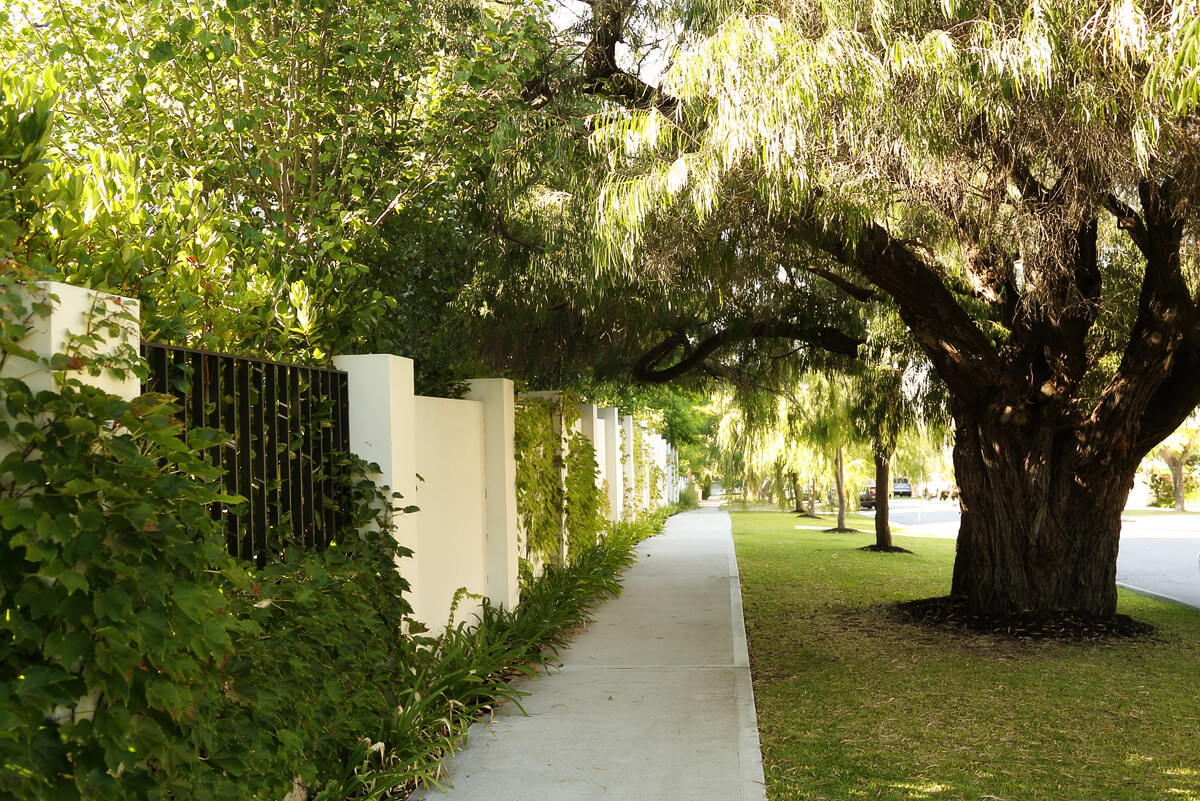
Trees make the City of Subiaco a beautiful place, and are an important part of the ecology and environment in urban areas.
Verge street trees are managed by the City. The City’s written approval is needed before pruning, damaging, or removing trees located on council property. Without this approval, you may be committing an offence.
As part of the Local Planning Scheme No. 5, the City maintains a Significant Tree Register. If you'd like to nominate a tree to be listed on the register, please fill out this form.
The City systematically selects, plants and maintains street trees, considering both existing and future streetscapes and the City’s environmental goals. Balancing site limitations, climate factors, safety, adjacent land uses and vehicle traffic, as well as physical characteristics of native and exotic trees, the City creates a leafy and shady environment for the community to enjoy.
For information about annual laneway pruning, please check the link below:
Around July each year, the City prunes or removes vegetation growing around laneways to create safe clearances around fence lines and remove dead vegetation.
Residents can opt-out of the City's laneway pruining program. If you choose to do so, you will need to maintain vegetation to the City’s requirements. Please visit Online Services to contact us or raise a request for tree pruining.
For more information on street trees please refer to the City's Street and Reserve Tree Management Guidelines.
Your verge
Residents are welcomed to establish and maintain the verge next to their property. The City encourages landscaping with low water use plants.
Landscaping developments to the verge not involving paving or any constructed elements, and complying with the City’s verge policy and management guidelines, may be undertaken without the City’s permission.
For more information about verges, please check the links below:
Infrastructure and verge protection bonds apply to development sites ensuring the City’s assets are not damaged by private development and construction. Bond costs are listed in the City’s schedule of fees and charges. For more information, please see Development Sites - Infrastructure and Verge Protection.
The City also provides information on verge compliance criteria, the verge development assistance scheme and tips on how you can green your verge:
• Verge Policy Fact Sheet: Verge Policy management guidelines
• Verge Policy Fact Sheet: Verge maintenance
• Verge Policy Fact Sheet: Verge paving guidelines
The City of Subiaco is a proud Gold Waterwise Council

The Waterwise Verge Rebate Program aims at helping residents to establish a waterwise verge adjacent to their property and achieve sustainability outcomes, such as water conservation and contributing to local biodiversity. This initiative is proudly co-funded by Water Corporation’s Waterwise Greening Scheme and forms part of our ambition for Subiaco to be a leading waterwise city.
The City is now offering rebates up to $500, and a workshop with experts to help residents replace their verge with native plants.
Applications will be open in January 2026 for the Waterwise Verge Rebate Program 2026.
Please view the information below to assist you with your native verge.
Polyphagous shot-hole borer (PSHB)
The City encourages residents to monitor trees on their property for PSHB, as early detection is key to minimising further impact on neighbouring trees.
There are a number of symptoms that indicate a tree may be infested, including:
- Beetle entry holes (approximately the size of a ballpoint pen tip)
- Discolouration or staining of wood
- ‘Gumming’; the appearance of thick resin or sap
- ‘Galleries’; intricate tunnels or galleries where PSHB farm fungus
- Frass; a noodling effect that can be present extruding from trees, produced by the beetle’s tunnelling
- Dieback.
Important trees to check are maple, willow, plane, coral tree and avocado.
Residents who suspect they have borer damage to trees should call the DPIRD’s Pest and Disease Information Service on 9368 3080 or email padis@dpird.wa.gov.au. Further information can be found at www.agric.wa.gov.au/borer