
- See & Do
- Things to see & do
- Public art
- What's New Nearby
What's New Nearby
New Public Art commissions contribute to 2026 upgrades to Rowland Street Carpark and the City’s Greenwalks initiatives including Little Xanthis Lane; Kannis Lane and the Barker Road entrance to the carpark.
Public artwork - Rear 173-175 Rokeby Rd
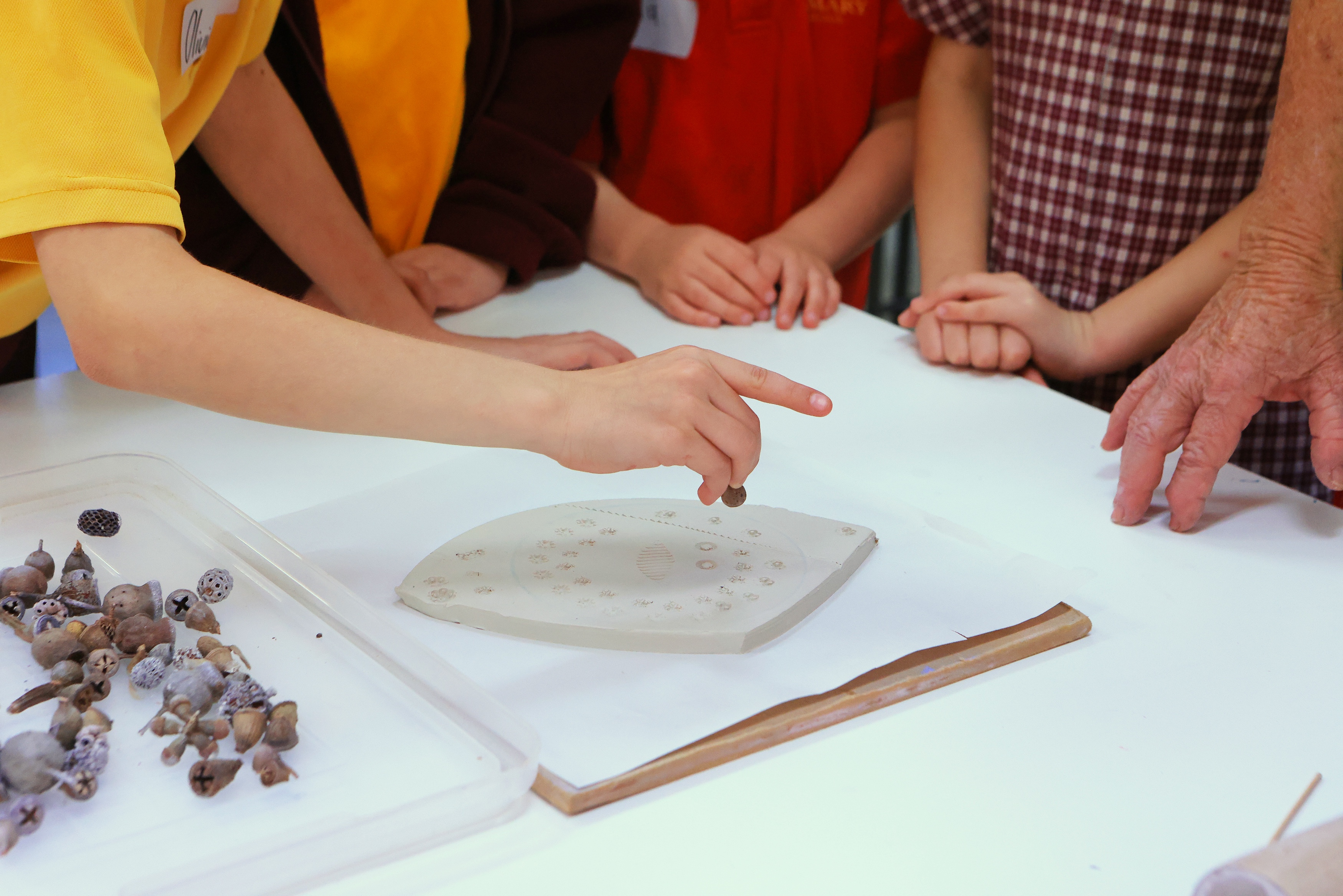
Nanninup
by Jenny Dawson (ceramic artist) and Sandra Hill (Nyoongar Visual Artist, Elder and cultural consultant).
Rupert Street Pocket Park, connecting Rupert Street and Bagot Road).
Artists Jenny Dawson and Sandra Hill collaborated on their first public artwork together in Subiaco in 1998 resulting in the Subiaco Centenary Tiles Project in Postal Walk. Jenny and Sandra have gone on to make many artworks together, and each has been publicly recognised many times for their contributions to arts and culture in WA. Notably Sandra won the Red Ochre Award in 2023 for Lifetime Achievement at the Australian Council for the Arts First Nations Arts and Culture Awards, while Jenny and partner Peter Zuvela took out the Creative Industries Excellence Award in 2020.
When parts of this earlier artwork were removed as the result of the expanding roots of a nearby flooded gum tree, the City of Subiaco received an influx of queries from people who had helped make these tiles whilst primary school students in Subiaco and continued to visit them, first with their parents and later with their own children and grandchildren. Former student Nick Teraci still frequents the area when popping in for a Saturday coffee at Citizens of Brew-Ha and admires his handiwork featuring Subi wildlife “I was only eight years old when I painted that tile,” he says. “I wasn’t very good at drawing but it’s pretty cool to see it still here now.” The removed tiles are celebrated in a 2023 artwork by Jenny Dawson, Preserving Our Shared History.
In response to the continued interest in the 1998 artwork, the City of Subiaco commissioned a further work by Jenny Dawson and Sandra Hill, working now with a 2026 group of Year 3 children from Subiaco Primary School. This latest collaboration brings this intergenerational story of collaboration full circle.
Six tiles designed by Sandra Hill introduce each of the Noongar six seasons , with six more tiles set into the cast concrete seating feature the Wagyl, continuing the themes of the earlier 1997 artwork. The childrens’ designs feature local flora and fauna and reference the importance of water in this area. Bushland textures and patterns are prominent in the design. Leaves and bush litter used in the designs are taken from the areas of remnant bushlands near and on the site enabling the work to celebrate a sense of place.
Sandra thoroughly researched the history of this area from an Indigenous perspective which is used as the basis for her original design for the metal panel artworks set into the top surface of the cast concrete seats. Her design for this artwork represents her artistic interpretation of the Indigenous sensibility associated with the history and connection to nature of the Subiaco area. She has referenced cultural knowledge passed on to her by many Elders in particular the late Shane Pickett (an acclaimed Indigenous Visual Artist) who was also Sandra’s consultant on Indigenous history on the earlier project completed by this team in 1997 The Subiaco Centenary Tiles Project.
See jennydawson.com.au and Sandra Hill | AGWA for more information about each of these artists.
Wandaraguttagurrup
Written by Sandra Hill 2025
Wandaraguttagurrup, now known as Subiaco, was used as a stopping and resting place. Aboriginal families living in the inland wheatbelt areas would follow the songlines or Bidi (tracks) that crossed over the scarp to the Booloo (Perth) floodplains to enjoy the cooler weather. Along the way they would stop and rest at Wandaraguttagurrup (Subiaco) before moving on to their final destination, the coast. Families would camp close to the ocean to fish, swim, hunt and participate in numerous recreational community activities.
The area around Lake Jualbup - ‘a place where water rises in the spring’ (Shenton Park Lake) was as welcoming to Aboriginal people as all freshwater lakes, freshwater springs and swamps were to Bibbulmun people. The areas around the lake were hunting grounds for Booyi (Long Necked Turtle), Noorook (eggs), Gilgie (Freshwater Crayfish), Kyooya (Frog) and water birds such as Kaalyuang (Brown Duck) and Maali (Black Swans), and many other Jirda (Birds). Other food resources bountiful in the area were Yonga (Kangaroo), Koomal (Brushtail Possum), Quenda (Western Brown Bandicoot), Naaren (Ringttailed Possums), Kaarda (Gould’s Monitor) and other reptiles such as snakes and lizards. Quandongs (Native peach), Bardi (witchetty grubs), Zamia nuts, Bohn (bloodroot) and Yandjet (Bullrushes) were also growing in abundance near the lake and in the wider area for people to harvest and enjoy.
The Wunnang tree (Peppermint tree) the Bibool (Paperbark Tree) and the Kwel (Sheoak) which continue to grow around Lake Jualbup held great Cultural significant to Aboriginal people back in the old times and still do today. The Bibool bark provides shelter for our winter Mia Mias (homes) which are a dome shaped form using the pliable branches of the Wunnang tree to build the frame, paper-bark was gathered and then attached to the Mia Mia frame which provided a dry shelter from the rain in the winter times. The Kwel is significantly a ‘woman’s’ tree and holds spiritual significance, when the wind blows through the needle like branches it’s believed to be the voices of our old ancestors.
Most importantly, it was a significant water source, part of an extensive wetland area that provided an abundance of food, water and shelter for Bibbulmun / Noongar people who travelled through on an annual basis. It is known that up to the 1950’s Aboriginal Custodians continued to camp, hunt and gather traditional foods at Lake Jualbup and the surrounding areas and wetlands then, transferred that Cultural knowledge on to the next generation.
Footnote: In the early days of settlement the lake was known as ‘Dyson’s swamp’ after James Dyson, it was then sold to George Shenton’s son in 1877 then, it was renamed after land developer, politician and Mayor George Shenton. The Subiaco Football Club used it and then Jualbup was used as a rubbish dump. It was then developed as a park in the 1950s / 1960s which decimated most of the natural landscape around the lake while still striving to retain the lake as a bird and tortoise sanctuary. In 1996, the City of Subiaco recognised the Cultural significance of the lake and restored its original traditional name, Jualbup.
Lake Jualbup is a Registered Aboriginal Site, one of six in Subiaco.
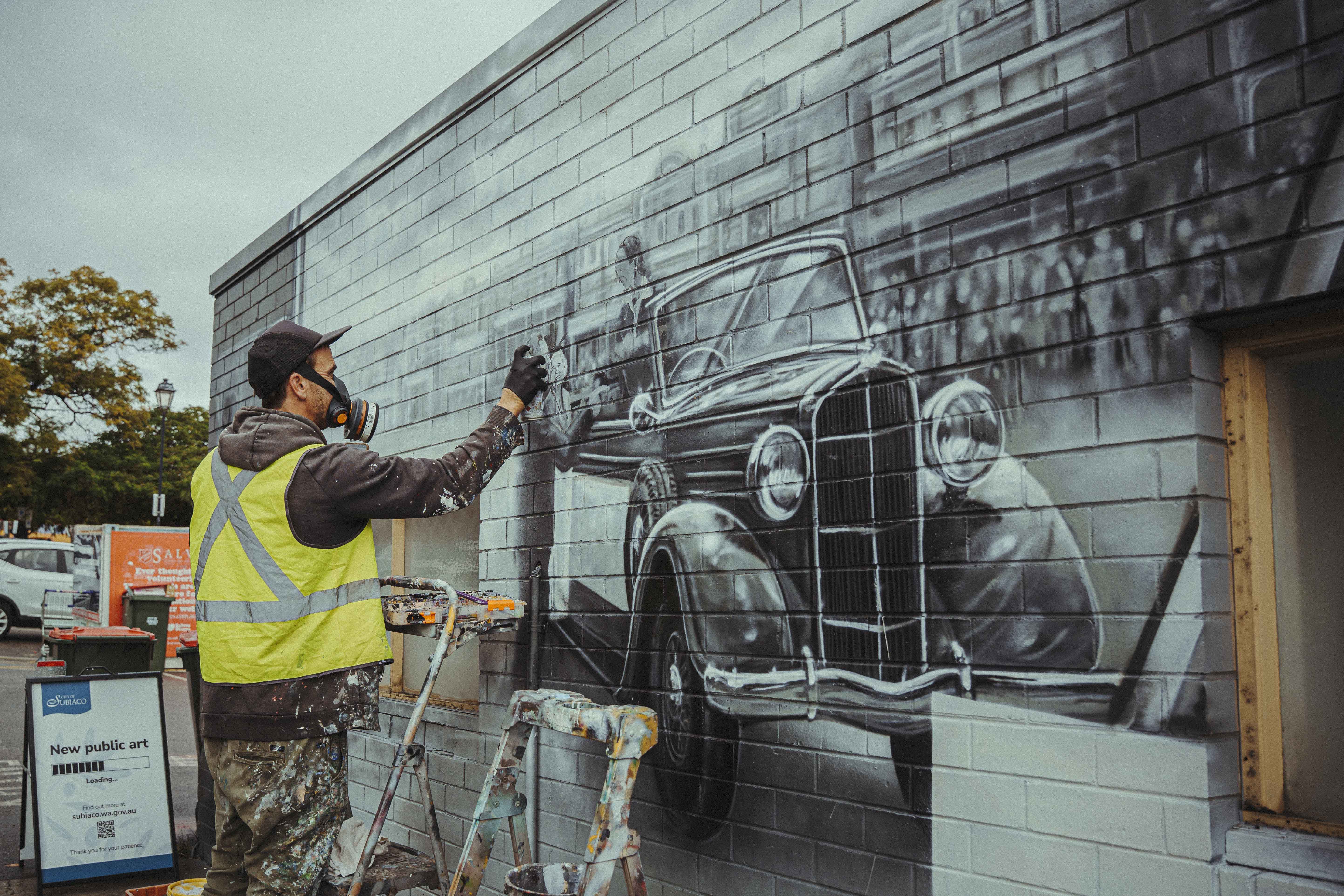
Leading the Way
Subiaco, 1952, By Jacob Butler aka Shakey.
325 Barker Road - The Third Place
Shakey specializes in large scale photorealistic murals which blend nostalgia with local identity. This mural on the wall of The Third Place is grounded in archival photography from the 1952 celebrations marking Subiaco's proclamation as a city, reinterpreted as an immersive monochromatic work at scale. Each has been visualised in-situ on the actual wall to communicate composition, scale and how the artwork integrates with the existing architecture, spanning the entire facade of the building. Key figures, groups and moments are drawn out of the crowd to build a layered narrative of community life, identity and civic pride. At the centre of the work is the Salvation Army — reflecting both their role in the 1952 celebrations and their continued presence on this site today.
The Salvation Army’s presence in Subiaco spans more than a century. Their band was a familiar part of Rokeby Road, playing on Friday nights, the great social occasion of the week. The Municipal Band played in front of the Post Office on Bagot Road and the Salvation Army played further down near Forrest Walk, their music forming part of the rhythm and identity of Subiaco. In the parade, the Salvation Army Band took its place among more than sixty units, uniformed and proud. The parade was described as “the greatest assembly of citizens Subiaco has seen’.
Shakey has included ‘easter eggs’ for attentive audiences to find. The celebrated if controversial Brigadier Arnold Potts DSO OBE MC who served in both World War 1 and World War 2, playing a critical role in the Kokoda Track Campaign, can be seen watching over the RSL float. A descendant of the Hiddlestone family and the artist’s own family watch the band pass by. Nuggets of Subi’s past are embedded in the detailed street façade which can be seen behind the parade. You can find some of the original images by exploring the online collection or visiting the Subiaco Museum.
Nearby are two other murals which recall Subiaco’s history. On the Tighe building is an artwork by Jordan Paolilo which references Fry’s Malted Cocoa once sold at Tighe’s General Store on this site, along with Still-Life with Pears by Danby, featuring the very collectable Wembley Ware formerly made in Subiaco.
Leading the Way joins Shakey’s Rolling Stills Art Trail.

Canopy
By Leanne Bray
Rear of 173-175 Rokeby Rd, facing onto Rowland Street Carpark
Leanne’s mural takes inspiration from the vivid blooms of the surrounding jacaranda and poinciana trees — and perhaps the deep red hues of the Cherubino wines found nearby. The artwork reimagines the playful, curving forms of spaghetti through Leanne’s distinctive approach to pattern and repetition. With a nod to the post-painterly abstraction of the 50’s and 60’s, the geometric patterning is a direct reflection of her current studio work and her rigorous approach to abstraction.

Little Figments
By Graeme Miles Richards
Little Xanthis Laneway between 173-175 and 177 Rokeby Rd
Graeme’s mural features a collection of miniature scenes designed to be discovered up close — a perfect fit for the intimate scale in Subiaco’s narrowest laneway linking Subiaco’s main thoroughfare to the Rowland Street Carpark.
Drawing upon elements featured in his earlier work Whimsey on Walmsley (next to Bar Amelie at 118 Rokeby Rd), this artwork extends the charm of Graeme’s imaginary world, where objects unexpectedly take flight, astronauts and their pets pause to ponder, and penguins fight for fair play. References to the busy goings on in Rokeby Rd abound for the attentive viewer to find. WA’s earliest postage stamp is a nod to the Post Office nearby. Italian shoes and bags fly free from Dimario Italian Shoes. Abundant imagery on both sides of the laneway remind the visitor about the many neighbouring restaurants which cater to our love of pizza, pasta and all things Italiano. It’s a peek inside the dada es
Delve further at https://graememilesrichards.com